

Most Common AI Adoption Challenges and How to Solve Them?
Aug. 29, 2025
1691

Table of Contents
- AI Adoption by the Numbers
- 1. Lack of Strategic Vision
- 2. Data Quality and Availability
- 3. Skills Gap and Lack of Expertise
- 4. Employee Resistance
- 5. Inadequate Financial Justification
- 6. Security Concerns
- 9. Over-Reliance on Third-Party Tools
- Benefits of Overcoming AI Adoption Challenges
- Final Thoughts
- FAQs
NTT Data report says "Between 70-85% of GenAI deployment efforts are failing to meet their desired ROI". Did you know that 70% of organizations report minimal or no impact from their AI initiatives despite heavy investments? This statistic tells us a harsh reality that successfully adopting AI is not as simple as plugging in a new technology.
AI has the power to automate repetitive tasks, uncover hidden patterns in data, and revolutionize decision-making across industries. However, many businesses face roadblocks that prevent them from unlocking AI’s full value. These challenges often range from lack of expertise and data quality issues to resistance from employees and unclear strategies.
In this article, I am going to tell you about the most common AI adoption challenges businesses face, and more importantly, how you can overcome them to make sure AI delivers real results.
AI Adoption by the Numbers
Before diving into the challenges, here are some key statistics that tell us more about AI adoption:
- 72% of organizations now use AI in at least one business function, up from 50% in 2023.
- 74% of companies have yet to achieve significant value from AI investments.
- 95% of AI pilot projects fail to scale beyond proof-of-concept due to poor strategy and integration issues.
- AI project failure rates range from 70% to 85%, making them twice as likely to fail as traditional IT projects.
- Companies that overcome adoption barriers can achieve 50% higher revenue growth and 60% higher shareholder returns than peers.
These numbers show that while AI adoption is growing, success is far from guaranteed. Let’s explore the top AI adoption challenges and how to solve them.
1. Lack of Strategic Vision
Why It’s a Problem:
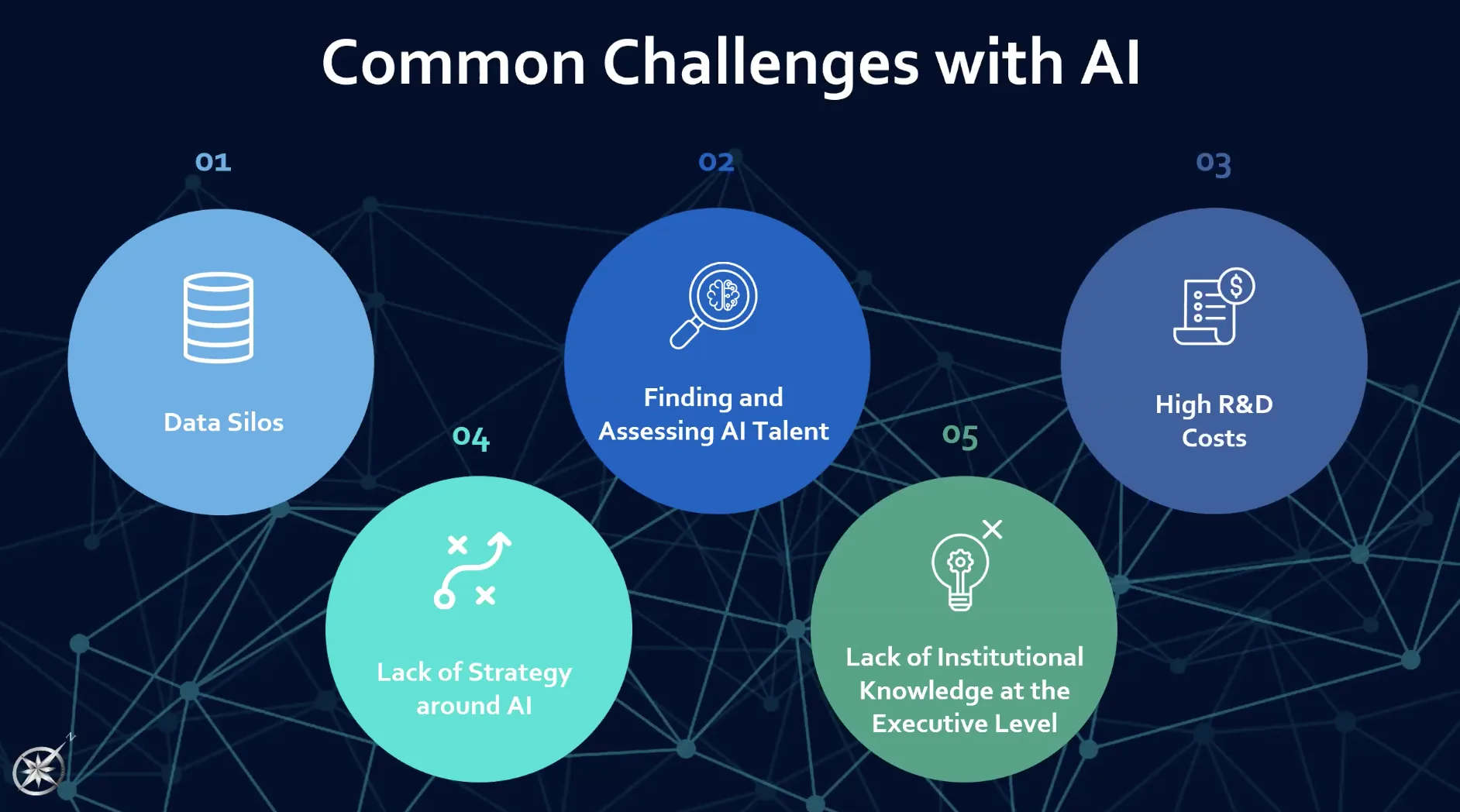
Many companies rush into AI because it’s trendy, without asking critical questions: What problem are we solving? How does this align with our business goals? This leads to fragmented projects, wasted budgets, and no measurable ROI.
A retail chain invested in AI-powered chatbots without aligning them with its customer service strategy. The result? Poor customer experience and low adoption because the bots couldn’t handle complex queries.
Solution:
To connect AI with real business value, start by making a simple roadmap that shows how artificial intelligence supports company goals. First, pick use cases that matter most, like demand forecasting to predict sales or fraud detection to keep transactions safe. Bring together teams from different parts of the organization, so everyone’s ideas and needs are included and departments work smoothly together. This approach helps solve real problems, and makes sure AI works for the whole business.
You can read about Why E-Learning Services Are Key to Empowering Employees and Driving Growth in 2025?
|
Benefit |
Description |
|
Revenue Growth |
1.5x higher growth & 1.6x greater shareholder returns. |
|
Cost Savings |
20–30% reduction in operational costs through automation. |
|
Faster Decisions |
Real-time analytics improve agility & competitiveness. |
|
Higher Productivity |
AI removes repetitive tasks, freeing employees for strategic work. |
2. Data Quality and Availability
Why It’s a Problem:
AI is only as good as the data it learns from. Incomplete, inconsistent, or biased data leads to inaccurate predictions and poor decisions. Many organizations also struggle with siloed data across departments.A 2025 Precisely and Drexel University report shows that 64% of organizations cite data quality as their top challenge impacting data integrity, leading to poor AI outcomes.
Solution:
You can set up a data governance framework to keep data organized and high quality. Use data cleaning and enrichment tools so your AI models get accurate and reliable data. Try synthetic data generation for cases where real data is rare or hard to find, this helps your AI handle unusual scenarios better.
3. Skills Gap and Lack of Expertise
Why It’s a Problem
AI requires specialized skills in data science, machine learning, and model deployment. Most organizations lack this talent, and hiring is expensive.Like, a mid-sized bank launched an AI credit scoring project but abandoned it because they couldn’t find skilled ML engineers to maintain the system.
Solution:
For this, You can upskill employees through training and certifications.Use low-code or no-code AI platforms for non-technical teams.For deeper knowledge, you can also team up with AI technology experts from vendors or universities. This fills skill gaps quickly.
4. Employee Resistance
Why It’s a Problem:
Employees often see AI as a threat to their jobs, leading to resistance and low adoption rates. This cultural barrier can derail even the best technology.Such as, a logistics company faced backlash when introducing AI route optimization because drivers feared job cuts.
Solution:
To ease concerns, clearly communicate that AI is designed to support and enhance human roles, not replace them. You can also Involve employees early by including them in small pilot projects, which builds trust and gives them a chance to see AI’s benefits firsthand.
Read about AI and Machine Learning: Enhancing Custom Software Development
5. Inadequate Financial Justification
Why It’s a Problem:
AI projects can be expensive, and without clear ROI, leadership hesitates to invest further. Many companies fail to measure success beyond cost saving. According to a 2025 AmplifAI report, companies that measure AI ROI carefully see returns of $3.71 for every $1 spent on generative AI. This highlights the importance of clear financial metrics to justify investments.
Solution:
To reduce costs and save time with AI, start small by running pilot projects and then scale up gradually as you learn and improve. Focus on use cases that have clear returns on investment, like automating repetitive processes that save both time and money. Keep track of key metrics such as cost savings, efficiency improvements, and how these efforts impact revenue to measure success and guide further action.
6. Security Concerns
Why It’s a Problem:
A joint Cybersecurity Information Sheet from top agencies in May 2025 highlights that AI systems handling sensitive data face major security risks such as data poisoning and supply chain attacks. AI systems often process sensitive data, making them targets for cyberattacks. Compliance with regulations like GDPR and CCPA adds complexity.
Solution:
To secure AI data, use encryption, anonymization, and differential privacy to protect sensitive information. Conduct regular security audits and compliance checks to identify and address risks. Also, implement ethical AI frameworks to ensure transparency and accountability in AI use.
9. Over-Reliance on Third-Party Tools
Why It’s a Problem:
Depending too heavily on external vendors can lead to vendor lock-in, high costs, and limited flexibility. A LinkedIn report explains how vendor lock-in occurs through infrastructure, data, and skills dependencies, creating long-term risks for businesses. Organizations may face escalating pricing, and restricted ability to adopt better technologies.
Solution:
Build a hybrid AI strategy by combining your in-house skills with vendor solutions. Ensure your data can be easily moved to avoid lock-in. Also, negotiate flexible vendor contracts to keep options open and control costs.
Benefits of Overcoming AI Adoption Challenges
|
Benefit |
Description |
|
Revenue Growth |
AI leaders achieve 1.5x higher revenue growth and 1.6x greater shareholder returns than laggards. |
|
Cost Savings |
AI-driven automation can cut operational costs by 20–30%. |
|
Faster Decision-Making |
Real-time analytics improves agility and competitiveness. |
|
Employee Productivity |
AI reduces repetitive tasks, freeing employees for strategic work. |
The key to success lies in having the right partner who can turn vision into reality, and that’s exactly what CodeSuite delivers. By bridging strategy, technology, and execution, CodeSuite helps businesses overcome AI adoption challenges and turn ambitious ideas into measurable results.Power your business with intelligent data engineering and AI solutions from CodeSuite.
Contact CodeSuite today, and let’s redefine what you can do!
Final Thoughts
AI has the potential to revolutionize business, but only if organizations overcome these AI adoption challenges. Success requires a balanced approach, investing in people, processes, and technology. Start small, scale smart, and keep innovation at the core.
FAQs
What are AI adoption challenges?
Problems like poor data, lack of skills, and resistance that slow AI success.
Why is good data important for AI?
AI learns from data; bad data means bad results.
Can AI replace human jobs?
No, it mostly automates repetitive tasks and supports humans.
How can companies fix the AI skills gap?
Train staff, hire experts, and use easy-to-adopt AI tools.
Is AI safe for private data?
Yes, with encryption, compliance, and strong governance.